Saturday, January 12, 2013

Scarred for life (or what's left of it)

‘Well, it’s going to leave a scar’, the doctor said as we stared at the gaping wound on my lower leg.
He wanted to stitch it.
I was trying to avoid having needles poked through my flesh.
‘I can cope with that’, I said calmly (secretly thinking: Ah ha. Now I can impress people who ask about my scars).

But that was five years ago and NO ONE HAS EVER ASKED.

Now this sad state of affairs is a product of my age.
Have you noticed that when you’re young, people are forever asking you how you acquired this blemish or that. And as a callow youth, all you can do is confess, ‘Okay, I’m a complete klutz’. Yes, I did mishandle a breadknife; yes, I did trip on the stairs.
But as you edge into middle-age, scars shift allegiance, traitorously teaming up with wrinkles, saggy skin and liver spots to become harbingers of age. And, goodness me, no one wants to mention them!

Of course, the phenomenon isn’t limited to bodily blemishes and I’m the first to rejoice in this unexpected benefit of aging. No longer must I endure prolonged and incredulous discussions about why I don’t want children (Oh God, she’s one of those unfortunate women who can’t have kids...) or hours of nonsensical harassment over imbibing distasteful beverages (don’t say anything; she’s obviously on the wagon...).
But I’m digressing shamelessly here (probably senility).
Since no one has ever enquired about the impressive scar on my right calf, I’m going to tell you about it here. And it serves you right for being so polite!

It was a dark and stormy night...
Well it was dark at least. Oh, and it was hot (I was wearing shorts).
Suddenly my dogs shot out the backdoor, barking wildly. Something stirred in the bushes beyond the garden and Magic (my husky cross) clambered straight up and over my dog-proof fence.
Aha, I thought, this isn’t one of our normal passersby.
You see, like all well-brought-up carnivores, my dogs detest other meat-eating beasts. When a porcupine, hippo or waterbuck tippy-toes past the garden they respond with a bark or two, but only a carnivorous creature can arouse them to such athleticism.

Envisaging the potential annihilation of some innocent little furbearer, I girded my loins for a rescue mission (scuffed my feet into thongs/flipflops and grabbed up my semi-flat torch/flashlight).
As I hurried through the thigh-high forbes below the garden, I could see Magic circling a large tree stump, barking frantically. Oh dear, some inoffensive critter must be hiding among the broken roots. A fur-fluffed genet maybe? Or a striped polecat, big-eyed and cowering? Shining my wavering torch beam carefully on the stump, I hastened toward Magic.
Then CRUNCH!
Something had sunk its teeth into my lower leg.
And let me tell you, this was no little mustelid.
With my mind still fixed on nocturnal mammals, I bewilderedly ran through the possibilities. A civet? A honey badger?
But even the most vicious honey badger couldn’t feel like this! Warm wetness was flowing down my leg and pooling stickily in my sandal. As I lowered the torch beam toward my leg, my mysterious attacker gave a head-shake, thrashing the vegetation wildly and almost flinging me off my feet. Then it let go. And I finally managed to get the light focused at my feet.
Oh God!
Right before me was the wide, tooth-filled gape of a crocodile.


What you don’t want to see two inches in front of you.

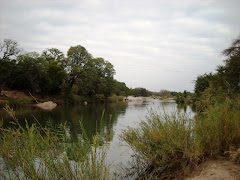
Now this was a shock. This is NOT what you expect to find at the bottom of your garden! Well sure, I live beside the Oliphants River, but the water’s edge is at least 250m/yards from my house.
The reptile, poised threateningly in a patch of flattened vegetation, was relatively small (for a crocodile) being about the same size as me (1.7 m / 5’6” long). And it was fixing me with a piercing death stare. Without thinking, I immediately stepped backward and the creature lunged toward me, it's mouth still agape. However, this time it kept its teeth to itself and I was able to slowly back away. As I hobbled squelchily back to the house, I found I was shaking head to foot.


Fortunately the teeth of the Nile crocodile (Crocodylus nilotus) are designed to grab and hold, rather than slice and dice. On the downside, crocodiles have the most powerful bite known for any living creature.
Photo by Silvain de Munck.

Now I don’t blame the crocodile for this assault. Clearly I’d blundered straight into it, and who doesn’t bite when stepped upon? I’m just profoundly grateful that it let go! A few years ago I read an article in the local paper about a crocodile that got into a swimming pool at a local game lodge. It grabbed a child (by a limb) and hung on. The girl’s grandfather managed to keep her above water, but it was half an hour before he could persuade the beast to open its maw. Unfortunately, the crocodile had to be put down afterwards because Granddad had had to gouge its eyes right out of their sockets before the crocodile would let go.

Now if you’ve ever lain awake at night worrying about how hard a crocodile can bite (and who hasn’t), a recent study by Gregory Erickson and his colleges in Florida will put your mind at rest. These intrepid researchers persuaded 83 crocodilians to sink their fangs into a waterproof, leather-encased bathroom scale (ain’t science grand). They measured the bite force of all 23 living species, from diminutive little fish-eaters to bloody great wildebeest-snatchers. And what they found was unexpected.


The toothy schnoz of the Indian gharial (Gavialis gangeticus) is a perfect fish-processing tool.
Photo by Josh More.

The Chinese alligator’s (Alligator sinensis) Walt-Disneyesque snub nose is custom-made for crushing mollusc shells.
Photo by Roger Smith.

It didn’t matter what a crocodile ate, or how its snout or teeth were shaped, the force of its bite was the same. What was important was the size of the beast; the bigger the croc (regardless of its species) the worse the chomp (note to self: don’t step on a large crocodile). The most powerful bite the researchers measured was inflicted by a whopping (5.3 m/17 ft long) saltwater crocodile whose teeth crunched down with a force of 3,700 pounds per sq inch (psi) or 16,400 newtons. Compare this to a human’s best bite (150-200 psi or 4,450 newtons) or that of a lion or spotted hyena (1,000 psi or 4,450 newtons) and you can see why crocodiles really are best avoided.

Using the measurements from this study, and scaling down to a 1.7 m crocodile, I figure that my scar was produced by teeth pressing into my flesh at a force of about 335 psi (or 1,500 newtons). This isn’t too bad really (it’s certainly better than a lion). I guess you can stop feeling sympathetic (you were feeling sympathy, weren’t you?).


The little raised black spots on the scales of crocodilians are touch-receptors, ten-times more sensitive than our finger tips. You can read about them here. Nile crocodiles, such as this one, have them sprinkled all over, but in alligators they’re restricted to the snout. Photo by Silvain de Munck.

Now you may be wondering what‘s brought on my current bout of crocobilia. Well I’m currently staying (temporarily I’m afraid) in a beautiful lodge perched on an outcrop above the river. And it has a swimming pool (oh, the luxury). Unfortunately my dogs - who presumably read the local rag - believe the pool is crocodile-infested and won’t set paw anywhere near it. Whenever I take a dip they look at me with tragic reproof, utterly convinced that this folly will cost me my life. And Magic’s paranoia doesn’t stop there; she’s sure we’re facing an invasion. With great heroism, she sits guard, day and night, on the verandah overlooking the pool and barks ferociously each time the floating bottle of pool chemicals drifts in the direction of the house. Sigh.

Magic on sentry duty.


Tuesday, December 25, 2012

A festivity of pups

One.... two, three....
Crouched in the dappled shade of a marula tree, I was counting pups.
Not pups of the canine persuasion; mongoose pups.
Now this was no easy feat because they were passing me at speed, curled into walnut-sized balls within the mouths of their caregivers.

Four... five...
Number five was having a rough ride, dragged along enthusiastically by nine-month-old Echo. Despite pointing his nose skyward and waddling on tiptoes, he simply wasn’t tall enough to lift his cargo clear of snags.
Six...
Oh, wait a minute, there’s one being carried back again...
Back to five...

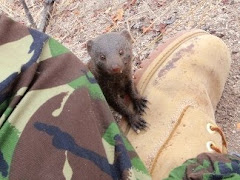
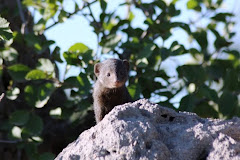
Koppiekats group was shifting its week-old pups to a new termite mound and it was my one chance to figure out how many there were.
Frenzied excitement gripped the group as mongooses dashed back and forth; some carrying pups, some not. Calling anxiously to one another, and with agitation-fluffed fur, some individuals raced ahead to check the safety of the new mound while others ran helter-skelter back to huddle the last nest-bound pups. Meanwhile the pup-carriers hurried on past, self-importantly announcing their passage with uninterrupted, high-pitched peeps (‘clear the way, pup coming through’). And the little ones - although tiny, black-fuzzed and blind - gave ear-piercing squawks whenever they were unceremoniously dumped beneath tussock or log.

Six... seven...
Eight!

No wonder the group was so excited.
Four is the normal size of a dwarf mongoose litter.
So how did Koppiekats end up with eight?


Koppiekats’ most recent progeny, venturing out at four weeks old. Pups stay snugged away inside a termite mound for their first three weeks of life, coddled and guarded by babysitters. With so many little ones, Koppiekats felt the responsibility keenly, usually leaving behind two or three minders.

As you probably know, dwarf mongooses - like their celebrated cousins the meerkats – are the living embodiment of the Musketeers’ motto. Dedicated to the ‘all-for-one and one-for-all’ maxim, group members team up to harry snakes, evict trespassers and warn one another of incoming raptors. With heroic selflessness, they forfeit their own romantic aspirations to devotedly care for the offspring of their group’s sovereigns. It’s all heart-warmingly altruistic.
In theory.
In reality, the Queen’s ladies-in-waiting are not quite so chaste. These heirs apparent (sisters and grown daughters of the Queen) are not above indulging in a little hanky-panky. And when the inevitable happens, they try to hush it up by smuggling the consequences into the royal nursery.

To help perpetuate the hoax, they give birth on the same day as the monarch. I don’t know how they manage this because the courtiers normally mate a day or two after the Queen. But when royalty decrees, loyal subjects follow, ready or not. It looks as if the illegitimate pups are simply borne a little premature (they’re smaller and have shorter fur). Even courtiers who are only ‘a bit pregnant’ honour the auspicious day, aborting their litters and discreetly nibbling up the tiny pink foetuses.


When spring is in the air, the ladies of the court don’t seem to be able to say ‘No’, and the sovereign is rarely alone when she delivers the first litter of the summer. This is Cricket, an errant Princess in Bugbears, awaiting the big day.


So what’s the fate of these illegitimate ankle-biters?
Well that’s in the paws of the Queen.
Normally they’re doomed.
Her Majesty swiftly transforms them into a restorative post-partum snack and the bereaved mums then act as wet-nurses for the rightful heirs. Fortunately (from my perspective) dwarf mongooses don’t believe in airing their dirty laundry in public so all I see of the nefarious deed is a bulging tummy and blood-smeared chin. Not so meerkats, who enact a horrifying spectacle in which the whole group tussles over the gory remains.

However, occasionally, if food is plentiful, the Queen grants a stay of execution. A genetic study of Serengeti’s dwarf mongooses found that 18% of pups reared by the group are the progeny of lesser females. Although the rulers of my other study groups were merciless this year, Pleiades, the sovereign of Koppiekats, opted for clemency. So some of the pups that just passed me are actually Pleiades’ nieces, nephews or grandkids.


The brood at six weeks. Notice the size difference between the legitimate pups (on the left) and the little interloper on the right. Yes, there is a question mark over his head: I don’t know who his mum is (because three courtiers - Spark, Helium and Mercury – were in the family way).

But even if they escape the death sentence at birth, illegitimate pups aren’t out of the woods. They face a second test. And it is this that has made me apprehensive every time I've visited Koppiekats.

You see at one month old, mongoose pups begin tagging along on the group’s daily foraging jaunts. Chivvied, cajoled and carried, the little ones are tended constantly. Carefully lodged under a log or boulder, the pups are then presented with half-chewed creepy-crawlies by doting group members.
But when the pups hit five weeks old, this mollycoddling stops. Although everyone still feeds them (and will do so for another five weeks), the youngsters are expected to look out for themselves. If the group runs, so must they. It doesn’t matter how far, or how fast; they must keep up. So if any pup is below par (debilitated from want of food, illness or underdevelopment), they’re simply left behind.

Although I loathe this phase of mongoose-rearing, it serves the mongooses well, ensuring that they channel their efforts only into the healthiest pups.
And I’m very relieved to report that all but one of the little Koppiekats pups managed to pass this trial. Aided and abetted by a timely glut of beetle lava, seven of the roly-poly little creatures live to tell the tale. In fact they’re doing so well, they spend most of their time playing rather than trying to cadge food from their betters.

Shell games.

Leaf games.

Bite-brother games.
 
If you were wondering, no-one left these pups out in the rain. The rusty patches on their fur are from daubs of ‘Camomile’ blonde hair dye (so I can tell who’s who).

Born on 31 Oct, the Koppiekat pups remain unnamed. I’m trying to come up with Halloween-appropriate monikers, but they also need to be associated with minerals (as in Twenty Questions). Darkness, maybe? Sulphur? Or Silver (for the bullets needed to pot vampires)? Any suggestions gratefully received!

I almost forgot.
HAPPY CHRISTMAS!!


Sunday, December 9, 2012

Fraternizing with the locals


WHOOOOP... WHOOOOOP... WHOOOOP...

The deep, resonant calls - each ascending smoothly in pitch - were spine-tinglingly loud.
I dashed outside into the cool, river-scented darkness. The night reverberated with the machinery-clatter of toads, cicadas and crickets, yet the eerie, other-worldly whoops were loud enough to thrum within my chest.

Somewhere, down below me in the riverbed, a spotted hyena was calling to his/her clan.

Now even if you’ve never been to Africa (and if you’re into wildlife, WHY NOT?); even if you’ve never seen a hyena in the fur, you’ll recognise these calls. Beyond any other sight or sound, the hyena’s whoops epitomize the African night (and feature in virtually every wildlife documentary ever made on this continent).
And of all the wild places in the world, Africa - at night - is probably the scariest. It's also our ancestral home. For millions of years our forebears stared out into the dark, shivering at the sound of the hyena’s call. It’s no surprise then, that the eerie whoops stir a deep, atavistic trepidation. Grinning insanely into the dark, I stood revelling in the trills of fear that fluttered up and down my spine.

[You can listen to a spotted hyena whooping here (button no 2)].


Hyena-kind evolved from mongooses and civets about 10 million years ago. The spotted hyena (Crocuta crocuta) has haunted the African savanna for as long as humankind's existed. It can also digest teeth (I just thought you’d like to know that).

Now I don’t want you to start thinking that hyenas whoop simply for our titillation. This long-distance call (audible up to 5 km/3 miles) is the SMS of the hyena-world. Roaming clan-members use it to keep in touch and call for assistance when uninvited visitors rock up for dinner.

Whoop-studying researchers - plotting the calls of different hyenas on spectrograms - found that each hyena has its own distinctive whoop; something I guess the hyenas already knew.
Although an individual’s voice gets deeper as it ages, the unique pattern of its whoops remain consistent year after year; so hyenas can recognise one another from whoop alone.

When researchers played back recordings of cubs (who start whooping at 3-4 weeks), the whooper’s mum (but not other mothers) rushed to the speaker (oh, that is unless Mum was dining, in which case she just glowered in the right direction – hey, you gotta get your priorities right). Close family members also responded, and the amount of time they spent eyeing the speaker was directly proportional to how closely related they were to the little whooper. In fact, hyenas seem to use whoops to flaunt their identity during brawls (and no one scraps as well as spotted hyenas).

Now I have to admit I wasn’t thinking about any of this as I stood at the bottom of my garden the other night. I was peering into the darkness, straining to pinpoint the exact location of the caller.
Umm, exactly which side of the river was the creature prowling?
Then my heart-stopped.
Directly behind me (and I’m talking one or two metres/yards) an answering call rose up. Fear clutched my chest as the eerie, resonant wail swelled upwards. But after a few moments I realised that the call was not a hyena’s. Although almost as loud, and with the same deep, tonal qualities, it continued to rise, and then undulate, in pitch. It was probably the most desolate sound I’ve ever heard. Still barely able to breathe, I crept toward the uncanny, penetrating wail.
What could make such a call?
And there it was; lying on my door mat.
My husky, Wizard.


‘You won’t believe the riffraff you meet around here these days’.
 
Now in truth, I couldn’t have been more shocked if I’d stumbled upon the cat reciting Shakespeare. This was like no dog’s howl I’d ever heard. It was a blood-curdling keening, evocative of wildness, primal instinct and vast empty lands. It was NOT something that should be emanating from a household pet! In the seven years that Wizard has companionably shared the humdrum domesticity of my life, I’ve never heard him utter such a sound.


Wizard, pining for the tundra?

I guess the whole incident made me realise that, just as our own hearts and minds were honed by millions of years on the African savanna, so too our domestic animals carry within them the legacy of their ancestors’ lives. It’s so easy to overlook our pets, to somehow believe they’re creations of our own (like TV or motor cars or computers). But our companion animals are profoundly wild beings, gifted to us with just the flimsiest wrappings of domesticity.
And what an utterly amazing privilege it is to share so intimately in the life of a wholly different species.

Sunday, September 23, 2012

Male nannies get the girls

One of the advantages of living above the river is the endless aeronautics display.

Step outside my door and you're treated to fork-tailed drongos fluttering and plunging, little bee-eaters, adorned in cinnamon and gold, effortlessly looping the looping and, way up above, tiny swifts floating like calligraphy bewitched from the page.

But among these master aviators, there’s one creature that surpasses them all.

Dressed like an accountant and encumbered by a massive ice-pick bill, it seems an unlikely candidate for aerial supremacy, but the pied kingfisher is utterly mesmerising.

Zooming along just inches above the water, it suddenly rockets upward 10m (33ft) into the air, and there it stalls. Completely. With its torso held almost vertically and its huge black bill pointing straight down, it hovers motionless; not just for a few moments, but on and on and on.


Pied kingfishers (Ceryle rudis) are the second largest of South Africa’s ten kingfisher species. This one’s double necklace of black reveals that it’s male; females are more demur, sporting only a single band. Photo posted on Flickr by Tarique Sani.

It’s at this point that I start feeling anxious. I know I should be excited at the prospect of the hunt, and I’ve seen other people clutch one another eagerly and cry, “Oh look, it’s about to dive!”
But as the bird just hangs there, flouting gravity, I find myself glancing at the pool below and wondering how anything can plunge at breakneck speed into one foot of water without suffering... er, neck-breaking consequences. As the bird continues to hover (for the next 5 to 10 seconds), pictures drift into my mind: murky underwater images of kingfishers stuck bill-first in the muddy pond floor.

Of course this never happens. Down the bird plummets, plunging below the surface and immediately surging back up - almost at the same speed (how does it do this?) - amid a glittering cowl of water droplets.


Pied kingfishers plunge-dive in waters throughout Africa, India, Myanmar and southern China. While African birds dine exclusively on fish, those living in Asia are less fussy, enjoying side dishes of aquatic insects and crabs.
Photo by Arno Meintjes.

But if the way pied kingfishers acquire lunch is bizarre, it’s nothing to the way they produce more little kingfishers.

Defying all kingfisherly conventions, this bird thumbs its nose wings its beak at the concept of territoriality.
And nuclear families? Well, who needs ‘em?

You see unlike other kingfishers, pieds gather together in busy breeding colonies. Using nothing but beak and claw, they gouge out 2 m (6.6 ft) long nesting tunnels in a communal bank, sometimes crowding their homes to within 0.5 m (1.6 ft) of one another.
And as if this isn’t social enough, loving couples also share their underground hideaways with up to six male nannies!


Born to burrow. The pied kingfisher's second and third toes are partly fused together; this is thought to help them shovel dirt.
Photo posted on Flickr by skuarua.

So how does all this come about?
Well, young pied kingfishers leave the family home normally at about four months of age, but if the guys don’t find themselves a girl (and 95% bomb out), they move back home with Mum and Dad. Now this isn’t as bad as it sounds because they do help out about the house. In fact, they put as much effort into their chores (guarding the chicks from marauding mongooses, monitors and rivals, and ferrying fish to them) as do Mum and Dad. Of course this is sensible (and so isn't the kind of behaviour you expect from young males): if you can’t have kids of your own, at least you can give your genes a push-start by helping your little brothers and sisters.

However, in some pied kingfisher colonies, pairs also take on unrelated childcare workers.

But why do these males want to hand over good fish to strangers?
And if there’s free help available, why don’t all colonies take advantage of it?
To get to the bottom of this fishy behaviour (sorry), Uli Reyer undertook a long-term study in Kenya, comparing kingfishers that lived on the windy shores of Lake Victoria (where non-related home-help is all the go) with those dwelling at flamingo-rimmed Lake Naivasha (where it’s unheard of).

He found that if you’re a pied kingfisher, Lake Naivasha is the place to be. Here the birds live a cushy life, feasting on plump native cichlids. Even without any help, pairs are able to successfully rear four healthy chicks.
But things are very different at Lake Victoria. The kingfishers here dine on slim, deep-water sardines which only come up to the surface at dawn and dusk. The birds must fly long distances over open water to reach their feeding ground water and the wind-whipped ripples reduce visibility. Only 24% of the birds’ dives snare a fish (compared with 79% at Naivasha), and pairs working alone can raise only 1.9 chicks. Half their hatchlings simply starve to death. So Lake Victoria kingfishers needed all the help they can get.


A juvenile pied kingfisher (and groups normally rear four) gulps down 35 g (1.2 oz) of fish daily and is fed for at least six weeks. But the fish the kingfishers catch average only 1-2 g (0.04-0.07 oz). Even without a calculator, that’s an awful lot of work!
Photo posted on Flickr by Lip Kee.

Just to make certain that it was the need to put food on the table that led to the recruitment of helpers, the researchers sneakily increased the workload of Lake Navaisha pairs by doubling their clutch to 8 to 10 chicks. Sure enough, these beleaguered parents happily accepted non-related nannies into their homes, even though this was not the done thing in their neighbourhood. In contrast, when families at Lake Victoria were reduced to just one or two chicks, the unburdened parents steadfastly rejected the approaches of potential helpers.

But all this doesn’t explain why unrelated males want to help.
If they don’t have younger siblings to care for, why don’t they just loaf about, marshalling their resources so they’re super sleek and sexy for the next breeding season?

Well Reyer discovered that 91% of these unrelated, live-in childcare workers landed themselves a girl the following year (compared with only 60% of the stay-at-home sons and 33% of the loafers).
What was their secret?
Well, almost half of these successful Lotharios teamed up with the female they’d helped the previous year!
You see fathering baby kingfishers really takes it out of you, and only about half of dads survive to breed the following year. And when hubby passes on, who’s right there, offering a consoling fish to the grieving widow? The live-in help, of course.

Unlike sons stuck at home (whose testes don’t even bother to produce sperm), unrelated helpers are all primed up for sex. This explains why Dad only accepts them into his family after his chicks hatch out and there's no chance of a bit of hanky-panky with Mum.
Photo by Andy Li. 


In fact, it looks as if the pied kingfishers’ unique nesting colonies actually serve as old time hiring fairs. Here, amid all the hustle and bustle, youths seeking childcare work can check out prospective families and advertise their availability (by presenting Dad with a gift of fish), and overworked parents can pick and choose whom they’d like to have help with the kids.


Looking smug? Traditionally kingfishers are associated with good luck. Photo by Martin Heigan.


Related Posts Plugin for WordPress, Blogger...